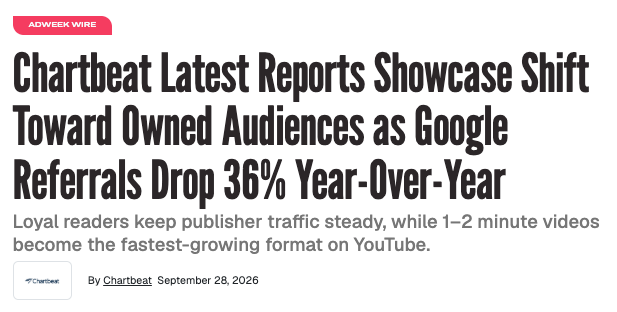
Web analytics firm Chartbeat reported that Google referrals to publishers dropped 36% year over year. Its 2026 Publisher Playbook has Google Search referrals down 40.2% from July 2025 to July 2026, after −21.9% the year before. Google Discover fell 34.3%, after −6.6%.
THE BIG DATA
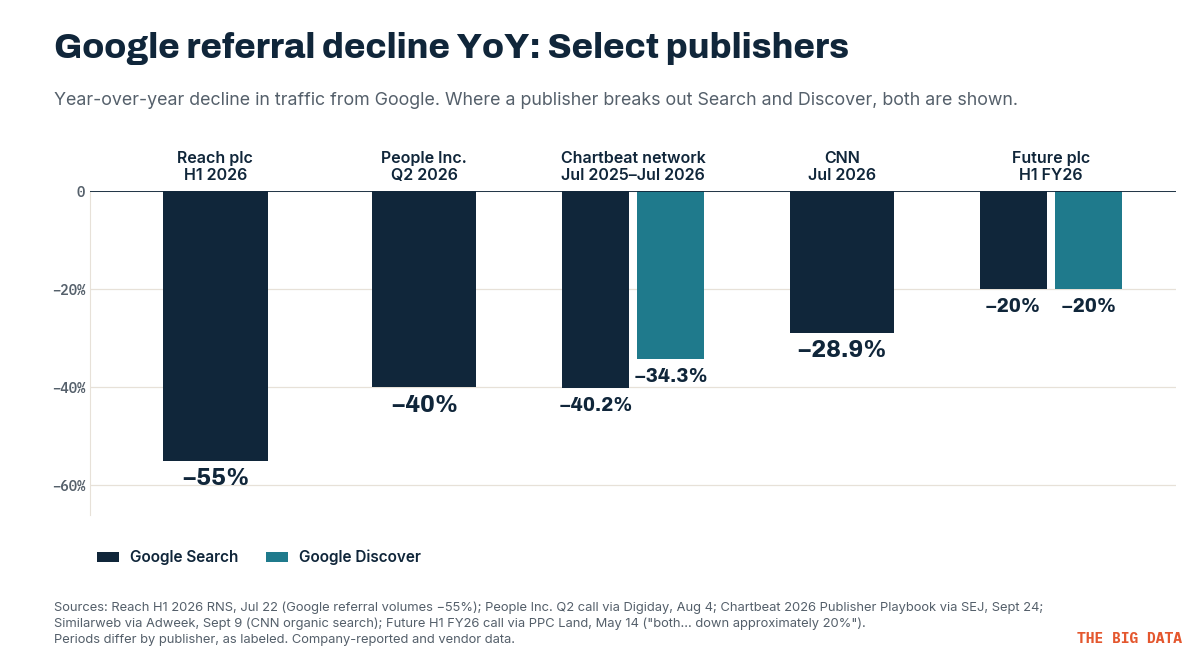
Across several major publishers, referrals from Google were down meaningfully YoY. In addition to those pictured above,
The Washington Post says its organic search has “fallen by nearly half in the last three years”
Newsweek’s total visits fell 72% YoY and Business Insider’s 42% YoY
Most pointedly, referrals from Google Discover (Google’s mobile content recommendation unit) were down by 34%. This is particularly important for news publishers, since Discover makes up two-thirds of Google referral traffic for major news sites, often surpassing traditional search (Chartbeat).
And this all happened while paid search spend amongst the top 100 publishers was up 41% YoY, and 274% over the past 3 years (Similarweb). Translation: as publishers are losing “free” referrals via organic search and Discover, they are partially replacing some of those via paid search.
Historically, buying organic search traffic for the sake of monetizing via digital ads has not been a sensible trade: the cost per click from Google vs. the revenue per impression from your advertisers are simply too far apart. So, if publishers are not buying search traffic to drive revenue or traffic numbers, the other reason could be to drive audiences to landing pages for conversion elsewhere (e.g. newsletters).
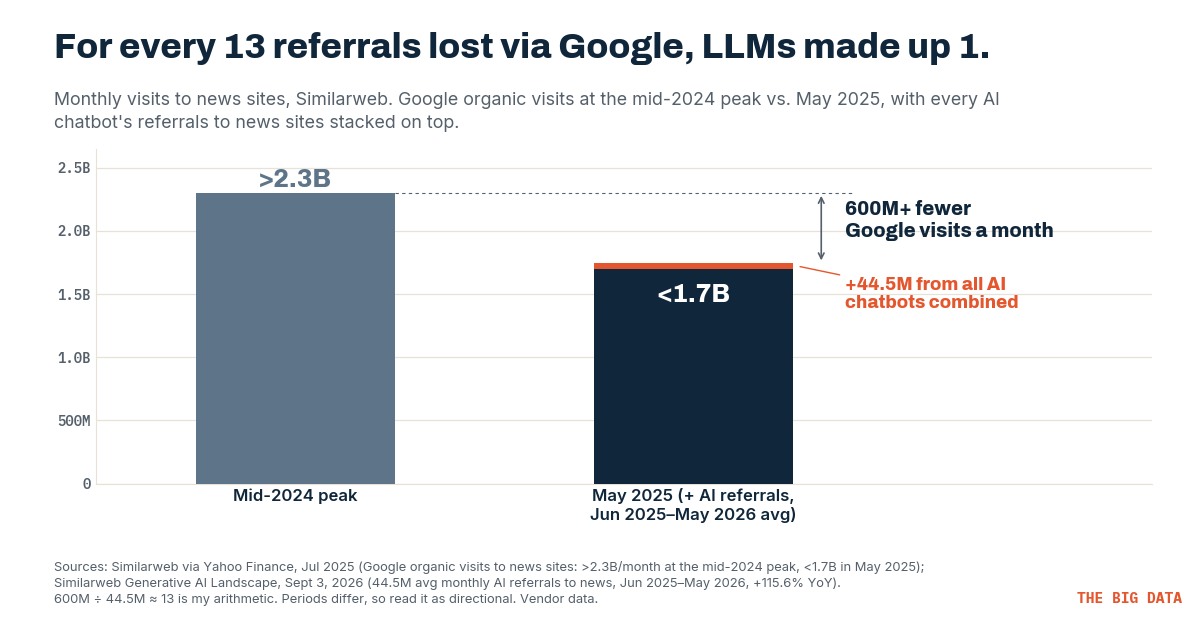
While monthly referrals from Google to news sites have fallen by ~650M between 2024 and 2025, referrals to news sites from all AI chatbots, combined, have made up less than 50M monthly visits over the past year. AI referrals have not materially closed the gap. Today, 68% of all U.S. Google searches end without a link click.
There has been significant interest in AEO/GEO (SEO but for LLMs) from the industry. As the above data shows, the impact of AEO should be entirely focused on increasing the publisher’s brand / audience footprint off-platform, as the likelihood of this type of work resulting in increased referrals appears highly unlikely.
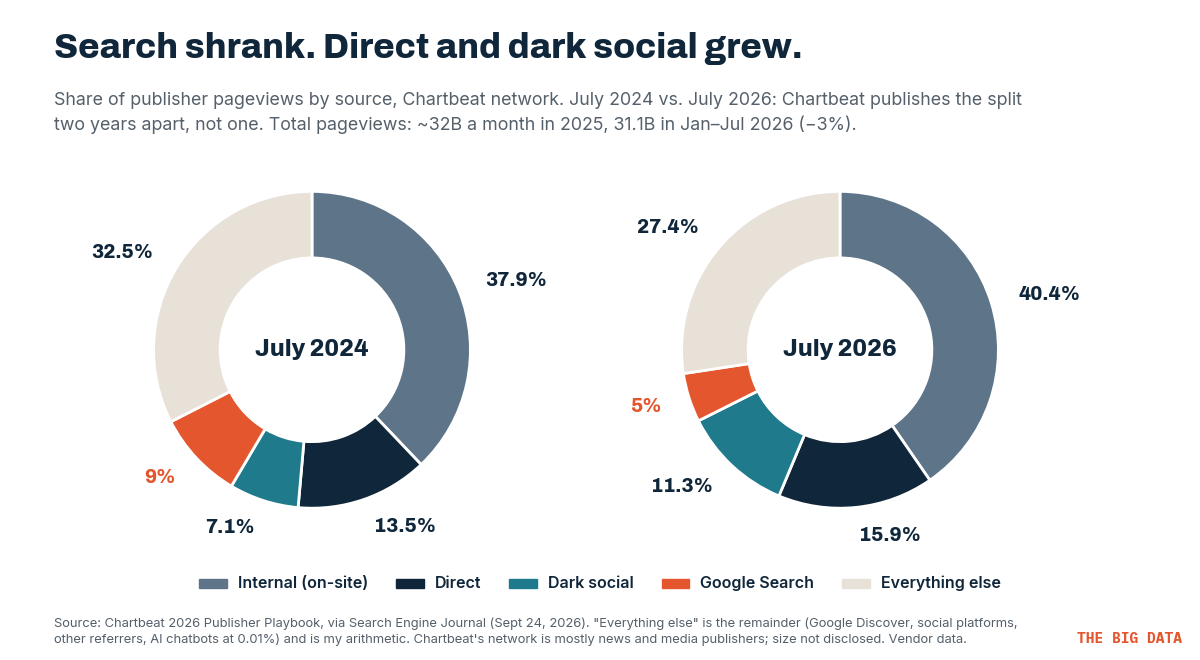
Interestingly, total monthly pageviews are only down 3% YoY. In particular, direct and “dark social” (person-to-person, untrackable sharing of website links) have made up the gap. Loyal users who have a more direct relationship with the brand remain more engaged than ever.
WHY IT MATTERS
In some ways, we’ve seen this movie before: Back in 2018, Facebook was 30% of publisher pageviews. By 2024, it was just 7%. One of the primary changes in digital news in the 2010s was a ‘platformization’ by social platforms of publisher web visits. Now it’s happening with Google, which had long been considered a more stable channel than social.
The best positioned publishers for the next cycle will be those who successfully bifurcated their strategies during the last cycle: build brand/audience via social/LLMs and drive monetization via premium, owned-and-operated channels such as email newsletter and in-person events. As the market for human-driven commodity content goes to 0, the winning publishers will focus on distinctive content (either in information, voice, treatment, etc).
In addition to diversifying business models away from web traffic-based advertising, publishers are also leaning on AI Labs for licensing payments. In addition to the mixed results from recent historic precedents (e.g. the relative failure of Facebook News’ licensing fee program), there are two primary challenges publishers must overcome with this strategy:
1) Can the size of payments offset the lost ad revenue?
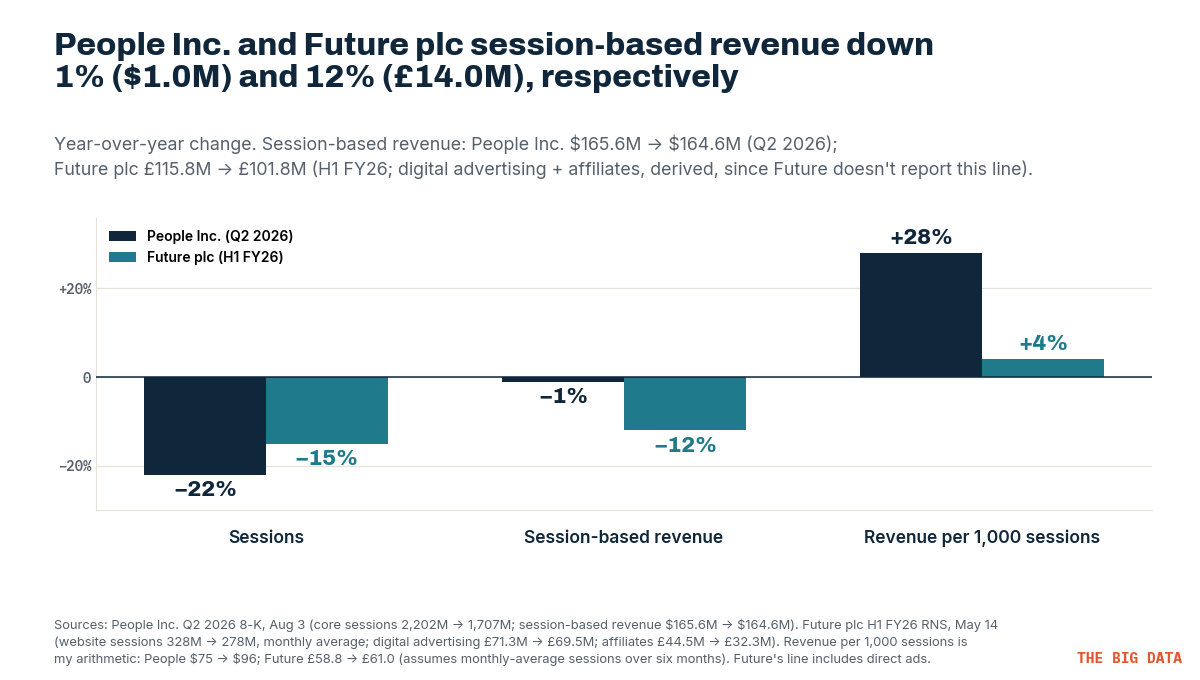
People Inc and Future Plc saw session-based revenue decline by 1% ($1M) and 12% (£14M), respectively. People has 3 disclosed AI licensing deals, with the OpenAI one reported to be at $16M+ / year. Future’s OpenAI deal has no reported details. From the outside, it appears People has gotten two things correct for now: successfully raising ad rates and striking fairly lucrative AI licensing deals.
2) Beyond the top handful of publishers, can small and medium sized news sites participate in licensing fees?
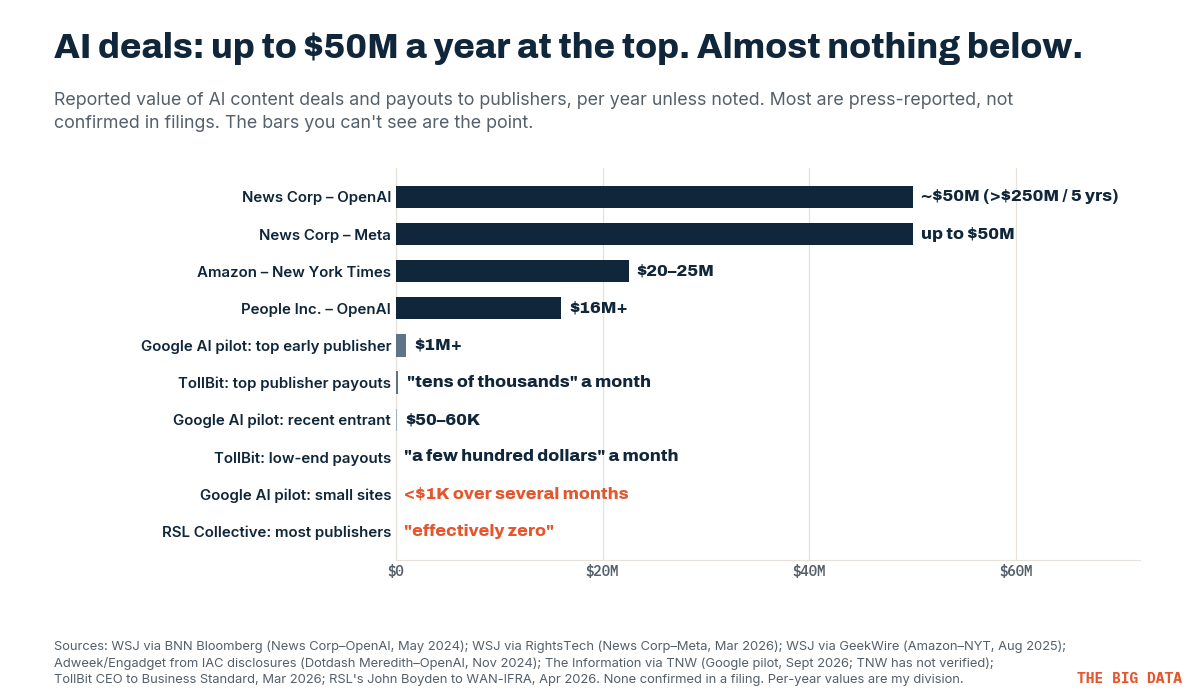
Currently, the data shows a handful of meaningful deals for top publishers. However, sources point to de minimus payments for the longer tail of websites. This strategy doesn’t appear to be credible for all but the world’s largest brands.
WHAT TO WATCH FOR
Trend #1: Increased contribution of non-traffic based revenue.
Email newsletters continue to hum:
Beehiiv reported that paid subscription revenue on the platform was $19M in 2025, up 138%, with $35M projected for 2026.
Semafor reported $40M of revenue in 2025 and its first profitable year, with 1M+ email subscribers.
Email newsletter outlet Puck was valued at $250M by Redbird.
IRL events is another bright spot:
TIME projected events revenue at 50% of 2026 revenue, up from 28% in 2023.
Axios Live revenue is up 30%+ this year.
Condé Nast events revenue rose 40% in 2025.
Trend #2: Legal challenges from publishers continue (final verdict: unknown).
Penske Media brought forth a suit arguing that Google provides publishers with no pay for AI Overviews and no way to opt out without disappearing from search. However, the judge dismissed it, stating “An expectation is not an agreement. It is simply how a general search engine works.”
The Stealth Bot Prohibition Act was introduced in July, which would ban companies from disguising a bot as a human visitor to collect content for generative AI. Resolution unknown as the bill is brand new.
Trend #3: The publishing industry comes together to assert its leverage (or at least attempts to).
Technical innovations can drive a more seamless value share. Cloudflare’s Sept 15 update blocks AI training bots by default on ad-supported pages (for new and free sites) while still allowing search crawlers (though Google’s own crawler does both, which complicates it).
The video industry – large media conglomerates which used their must-have programming to assert value for secondary networks – provides an interesting precedent.
Likewise, the music industry – whose labels demand terms for their entire catalogs before unlocking the most attractive parts of that catalog – is another interesting case study.
MONITORING THE SITUATION
YouTube says people watch more than 1B hours on TV screens every day, and over half its top 100 creators now get most of their views on TV. YouTube’s campaign to encroach on the TV screen continues its upward trajectory. Nielsen’s The Gauge suggests YouTube captured a record-high 14.2% share of total U.S. television viewership in July 2026.
Kalshi is in talks to raise at a $40B valuation, nearly double May’s $22B, and September volume hit a record $53B. This comes within days of a federal appeals court rejecting Kalshi’s “swaps” logic, which the company has used to avoid state sports betting laws. At the same time, DraftKings’ stock hit 3-year lows, even as “handle” was up 15% YoY.
Ticketmaster lost its bid to dismiss the FTC’s bots suit. The initial 2025 claim was that Ticketmaster let big ticket brokers break its own per-customer purchase limits, then earned a second fee when those tickets were resold on its own marketplace.